Every RF engineer eventually faces this decision: grab a standard RF component off the shelf, or invest the time and budget to develop a custom solution. The answer isn't always obvious.
The global RF components market was valued at USD 44.41 billion in 2025 and is projected to reach USD 91.19 billion by 2031, growing at a CAGR of 12.74%. With 5G base station deployments accelerating, automotive radar systems expanding, and LEO satellite constellations launching, the demand for RF components — both standard and custom — has never been higher.
But here's the problem: standard products are fast and cheap upfront. Custom components are slower and more expensive initially — but often deliver better long-term results. So which one should you choose?
This article breaks down the real differences between OEM RF components and standard products, when each makes sense, and how to make the right call for your project.
What Are Standard RF Components?
According to RF Essentials, a standard RF component (catalog component) is a device listed in a manufacturer's product line with fixed specifications, available for purchase in any quantity from distributor stock.
Think of them as the "one-size-fits-all" option. They're designed to work across a broad range of applications but aren't optimized for any specific one.
Common examples:
-
2-way and 4-way power splitters with fixed frequency bands
-
Directional couplers with standard coupling values (10dB, 20dB, 30dB)
-
Off-the-shelf antennas with generic gain and radiation patterns
-
Standard N-type and SMA connectors
-
Catalog filters, attenuators, and matched amplifiers
Key characteristics:
-
Immediate availability — often ships in 1-3 days
-
Predictable cost, published datasheets with guaranteed specifications
-
Multi-source options available
-
No engineering involvement required for selection
The trade-off: Standard components save 80-95% in upfront costs and 90% in time compared to custom designs. But they're seldom optimized to meet the specific electrical, mechanical, and environmental requirements of a proprietary design.
What Are OEM Custom RF Components?
An OEM custom RF component is engineered to meet a specific customer's unique requirements, with specifications, form factor, and sometimes the underlying circuit topology tailored to the application. Standard functions (connectors, attenuators, general-purpose filters, matched amplifiers) are sourced from catalog, while application-specific functions (unique band planning, non-standard integration requirements, special form factors) require custom design.
Custom components are common for:
-
Waveguide assemblies with custom flange configurations and routing
-
Filter assemblies with custom center frequencies, bandwidths, or rejection specs not available in catalog
-
High-power combiners/dividers with custom port count, power rating, or frequency
-
Antenna systems with custom gain patterns, polarization, and physical mounting
-
Integrated RF front-end modules combining amplifiers, filters, switches, and control in a single package
Key characteristics:
-
Optimized performance for the specific application
-
Integration of multiple functions into a single assembly
-
Non-standard form factors or interfaces
-
Specifications impossible to achieve with any catalog product
The trade-off: Custom components have higher upfront costs — NRE (non-recurring engineering) fees typically range from $5,000 to $20,000+ for simple custom designs. Lead times range from 4-6 weeks for simple modifications to 6-12 months for fully custom development. But they deliver optimized performance, easier integration, and intellectual property protection.
OEM Custom vs Standard: Five Core Differences
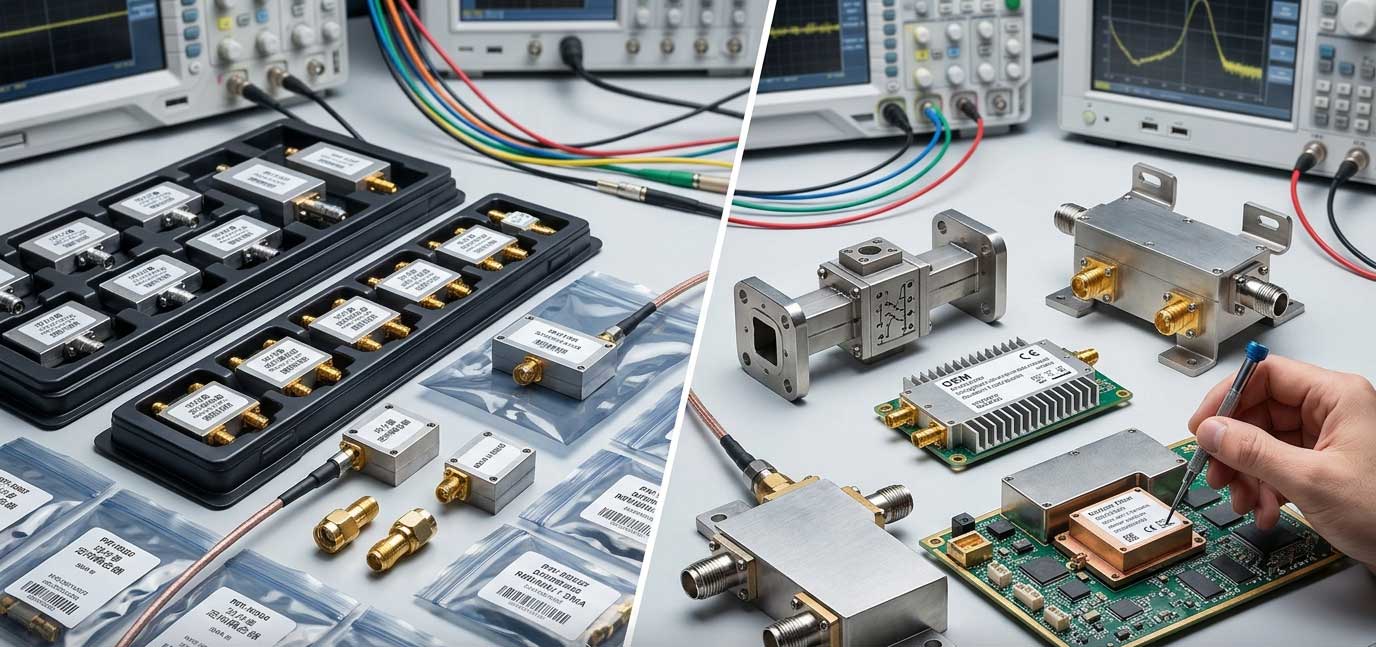
1. Performance
Standard components are designed for general-purpose use. They work reasonably well in most applications but aren't optimized for any specific one. A typical standard antenna might have ±5% frequency variance and fixed omnidirectional radiation patterns.
Custom components are application-tuned. They can achieve 3-5dB higher gain than standard options. In high-interference environments, custom solutions can reduce signal loss by 15-20dB through precision polarization control.
What this means for you: If your application has tight tolerances, operates in a challenging environment, or requires specific frequency bands not covered by standard products, custom is the only path to achieving the performance you need.
2. Cost
Standard components have lower upfront costs. Standard antennas save 80-95% in upfront costs compared to custom designs. But the per-unit cost is higher because you're paying for the manufacturer's margin and overhead.
Custom components have higher upfront costs (NRE fees) but lower per-unit costs at volume. The break-even point versus off-the-shelf typically occurs at 100-1,000 units depending on design complexity. Once you've paid for the engineering and tooling, each additional unit costs significantly less.
What this means for you: If you're building 50 units, standard components are almost certainly cheaper. If you're building 5,000 units, custom components often become the more cost-effective choice.
3. Development Time
Standard components ship immediately — often within 1-3 days. No engineering involvement required. You can have a prototype running in days, not months.
Custom components take time. Simple modifications to existing designs take 4-6 weeks. Fully custom development takes 6-12 months. Custom antennas require 8-12 weeks for prototyping versus immediate availability of standard models.
What this means for you: If speed to market is your top priority, standard components win. But if you can afford the development time, custom components deliver better long-term results.
4. Form Factor and Integration
Standard components come in standard packages designed for general use — not your specific enclosure. You may need to redesign your product around the component rather than the other way around.
Custom components can be designed to fit your exact mechanical requirements. This includes custom mounting arrangements, special connector orientations, built-in heat sinking, and direct PCB integration without coaxial connectors.
What this means for you: If your product has tight space constraints or unusual mechanical requirements, custom components can save you from compromising your design.
5. Environmental Reliability
Standard components are typically qualified for commercial environments but may not meet the requirements for outdoor, industrial, or military applications.
Custom components can be designed and tested for specific environmental conditions: -40°C to +85°C operation, IP67/IP68 ingress protection, vibration and shock resistance, and corrosion resistance for marine environments.
What this means for you: If your equipment needs to survive harsh conditions, custom components with proper environmental qualification are worth the investment.
When Should You Choose Standard RF Components?
Standard components are the right choice when:
|
Scenario
|
Why Standard Works
|
|
Low production volume (<100 units)
|
NRE costs for custom design can't be amortized
|
|
Standard frequency bands
|
800MHz, 900MHz, 1800MHz, 2100MHz, 2.4GHz, 5GHz are well-covered
|
|
No unusual mechanical constraints
|
Standard packages fit your enclosure
|
|
Speed to market is critical
|
Get to market in weeks, not months
|
|
Budget is tight
|
No NRE fees to pay upfront
|
|
Commercial environment
|
No extreme temperature, vibration, or weather requirements
|
Standard components dominate the market because they're cheap and fast. A typical Wi-Fi 6 dipole antenna costs $30, delivers 5dBi gain, and fits 90% of router enclosures. For many projects, that's good enough.
When Should You Choose OEM Custom RF Components?
Custom components are the right choice when:
|
Scenario
|
Why Custom Works
|
|
High production volume (>500 units)
|
Per-unit cost savings justify the NRE investment
|
|
Unique frequency requirements
|
Standard products don't cover your bands
|
|
Tight performance specifications
|
Need ±0.5dB precision or specific radiation patterns
|
|
Space-constrained design
|
Need components that fit your exact form factor
|
|
Harsh environment
|
Need IP67, -40°C to +85°C, or vibration resistance
|
|
Intellectual property protection
|
Custom design stays yours, not shared with competitors
|
|
Differentiation
|
Custom components help your product stand out from competitors
|
Custom RF circulators, for example, require tailored frequency ranges, power handling, mechanical structures, and testing for specific RF systems. They cost more upfront, but they reduce system-level risk, improve RF performance, and avoid costly redesigns later.
The "Semi-Custom" Middle Ground
Not every project needs a full custom design, and not every project can use standard components off the shelf. Many RF component manufacturers offer semi-custom options — modifications to existing catalog products at lower cost and shorter lead times than fully custom designs.
Common semi-custom modifications:
-
Different connector types (SMA instead of N-type)
-
Different frequency tuning (center a filter to your specific frequency)
-
Alternative mounting configurations
-
Custom labeling and marking
These semi-custom options typically add 2-4 weeks to lead time and 10-30% to price. They're a good fit for mid-volume orders (200-1,000 units) where full customization isn't cost-effective.
Decision Framework: A Step‑by‑Step Process
Here's a practical process for deciding between standard and custom RF components:
Step 1: Define Your Requirements
Write down your non-negotiable specifications:
-
Frequency range and bandwidth
-
Insertion loss, isolation, and VSWR requirements
-
Power handling
-
Physical size constraints
-
Operating temperature range
-
Environmental protection (IP rating, vibration, humidity)
-
Production volume (prototype and production)
-
Timeline
Step 2: Check What's Available
Search catalogs from major suppliers. Can you find a standard component that meets at least 90% of your requirements? If yes, standard might work. If no, custom is your only option.
Step 3: Run the Numbers
For standard components: Total cost = Unit cost × Quantity
For custom components: Total cost = NRE fee + (Unit cost × Quantity)
The break-even point typically occurs at 100-1,000 units depending on design complexity. If you're above that threshold, custom often makes financial sense.
Step 4: Consider the Intangibles
-
Will a standard component force you to compromise your product design?
-
Does your product need to stand out from competitors?
-
Will harsh environments cause standard components to fail prematurely?
-
How much is speed to market worth to your business?
Step 5: Talk to a Manufacturer
Contact a manufacturer with both standard and custom capabilities. A good manufacturer will help you evaluate the trade-offs and recommend the most cost-effective solution — not just the one that makes them the most money.
Why Maniron for OEM RF Components?
Maniron has been a leading manufacturer of RF components since 2002, headquartered in Hefei National Hi-tech Industry Development Zone. The company is composed of many high-level technologists with deep expertise in RF passive components.
What sets Maniron apart for OEM projects:
-
Professional OEM/ODM services across the full range of RF passive components — power dividers, directional couplers, combiners, duplexers, tappers, filters, and antennas
-
Wideband coverage from 350MHz to 7125MHz, supporting everything from legacy UHF bands to 5G NR
-
Low PIM performance meeting the stringent requirements of modern DAS and 5G networks
-
24-hour technical support — sales and engineering teams available around the clock
-
Full-spectrum testing with lot-level traceability, ensuring consistent performance across production runs
-
Flexible customization — Maniron can modify existing designs or develop entirely new components to meet your specific electrical, mechanical, and environmental requirements
Whether you need a standard component from the catalog or a fully custom design, Maniron has the engineering expertise and manufacturing capability to deliver. The company's OEM services allow you to protect your intellectual property while getting components that are precisely tuned to your application.
Conclusion
There's no universal "right" answer to the standard vs custom question. The right choice depends on your specific project requirements, production volume, timeline, and budget.
Standard RF components are the pragmatic choice for most low-volume projects, prototypes, and applications with standard requirements. They're fast, cheap upfront, and readily available.
OEM custom RF components are the strategic choice for high-volume production, unique requirements, harsh environments, and products that need to stand out from the competition. They cost more upfront but deliver better performance, lower per-unit costs at volume, and intellectual property protection.
The smart approach: Start with standard components for prototyping, then move to custom components for production if the volumes justify it. And when you need custom components, work with a manufacturer like Maniron that has the engineering depth, manufacturing capability, and commitment to quality to deliver components that meet your exact specifications.
Because in the end, the best component isn't the one with the lowest price or the fastest delivery. It's the one that makes your product work the way it needs to work — reliably, consistently, and for the long haul.